Rózsa, Ligeti
Stark, Bhriain


Nurit Stark, violin
Aoife Ní Bhriain, violin
M. Rózsa (1907-1995)
Sonata for two violins op. 15a
G. Ligeti (1923-2006)
Duo
25’ | Admission €10
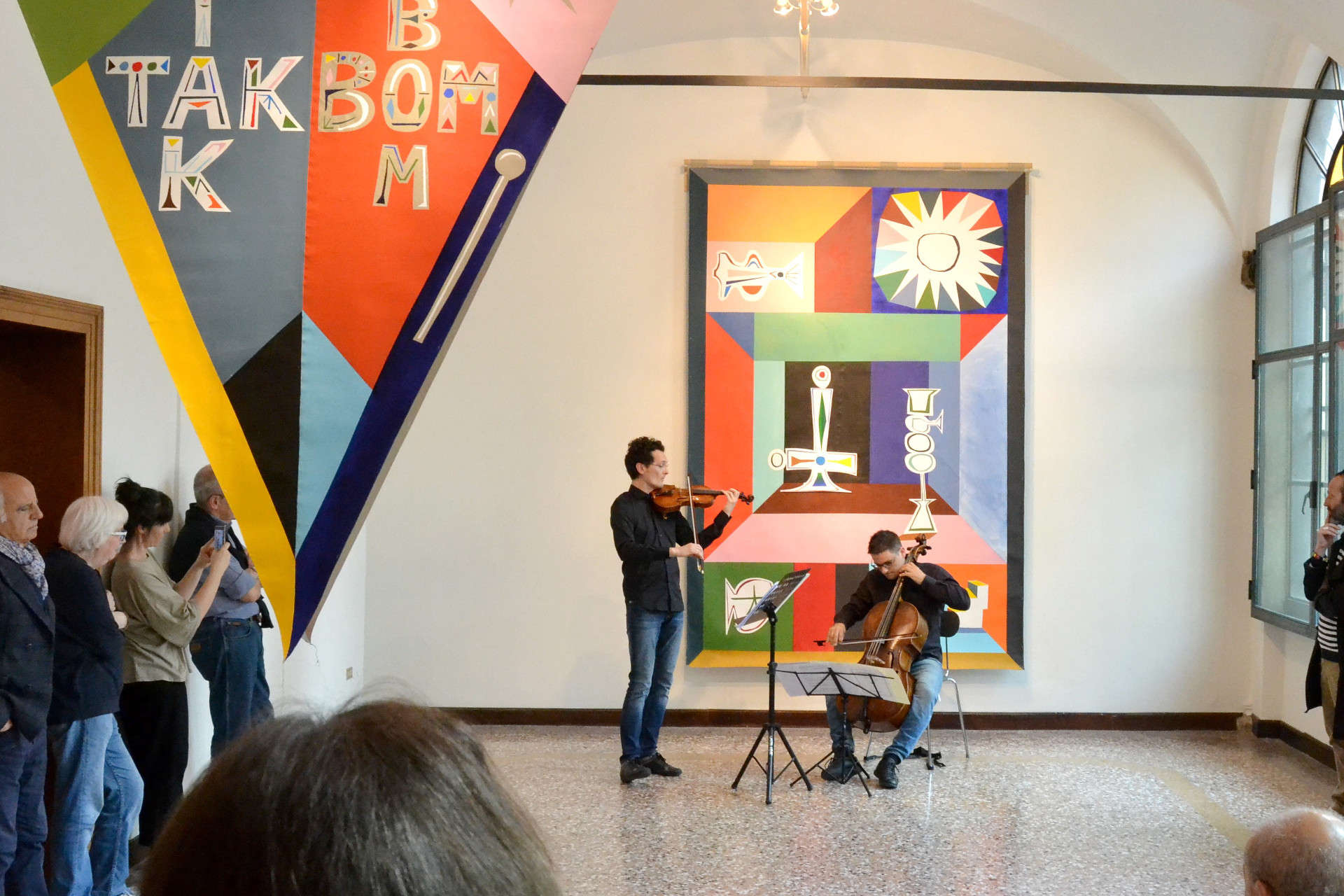
In the setting of the Corraini Gallery, contemporary art finds a natural extension in the sonic dimension entrusted to Nurit Stark and Aoife Ní Bhriain, performers capable of combining analytical precision and expressive freedom in a highly intense musical dialogue.
The guiding thread of the programme is the figure of Béla Bartók, evoked and reflected through the distinct poetics of Miklós Rózsa and György Ligeti, in an ideal journey across twentieth-century Hungarian music between folk tradition, modernism, and the reinvention of musical language. Rózsa’s Sonata for two violins already reveals in its opening Allegro risoluto a vigorous motoric impulse, supported by solid counterpoint and a harmonic language that, while moving at the edges of tonality, always maintains a clear formal direction. In the Lento assai, the writing unfolds into a contemplative lyricism tinged with melancholy, evoking vast and suspended landscapes of the Central European tradition. The concluding Vivo giocoso bursts into a brilliant and virtuosic dance, where syncopations, pizzicatos, and tight interweavings transform the two instruments into a compact and driving orchestral organism. With Baladă şi joc, Ligeti implicitly gathers the legacy of Bartók’s 44 Duos and projects it into a more personal and radical dimension. The lyricism of the Baladă is built on an intricate imitative play, in which the two violins chase and mirror each other like a system of continuous echoes, recalling archaic vocality and the stratification of folk traditions. In the Joc, by contrast, the dancing energy becomes increasingly urgent: the performers move with the freedom and instinct of Eastern European folk festivities, leading to a sweeping finale in which acceleration turns into pure physical impulse.
Text curated by Martina Sangermano
Trame